Research / the published record
The published CJC-1295 research, read straight
Two human pharmacokinetic studies, a rat bioconjugate paper, a knockout-mouse growth study, and a proteomics note — the genuine evidence base, with its concerns and its gaps marked.
The human pharmacokinetic studies
The CJC-1295 research that matters most is small and almost two decades old, and it is honest to say so. In healthy adults aged 21 to 61, single subcutaneous doses of 30 or 60 micrograms per kilogram produced dose-dependent 2- to 10-fold increases in mean plasma GH for six days or more, and 1.5- to 3-fold increases in IGF-1 lasting nine to eleven days; after multiple doses, IGF-1 remained above baseline up to 28 days, and the analog's half-life was estimated at 5.8 to 8.1 days [1]. This is the foundational human finding — the reason a once-weekly or less-frequent GHRH signal was ever plausible.
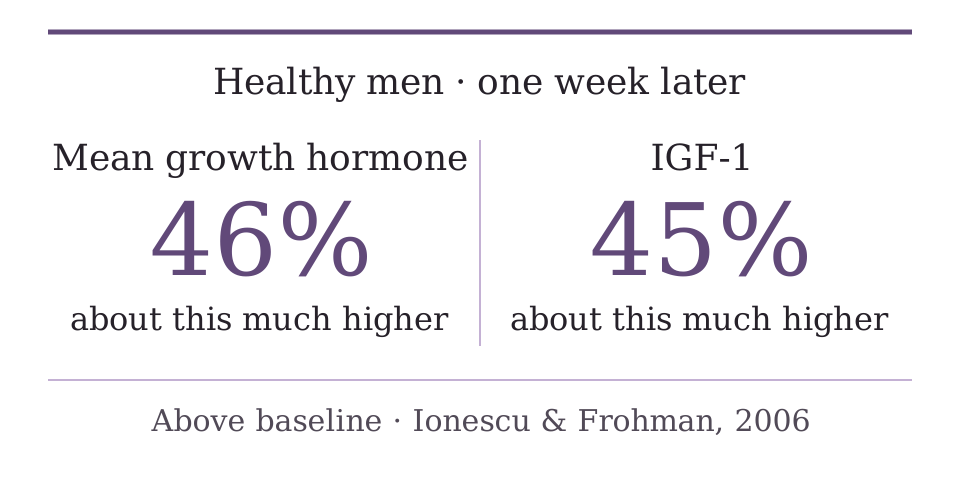
A companion study in healthy men aged 20 to 40 sharpened the picture. A single dose of 60 or 90 micrograms per kilogram raised trough GH roughly 7.5-fold and lifted mean GH by about 46 percent and IGF-1 by about 45 percent a full week later [2]. Critically, the frequency and amplitude of pulsatile GH secretion were unchanged — GH still came in pulses, not a flat infusion, despite continuous receptor stimulation [2]. That preserved pulsatility is one of the few genuinely distinctive results in the literature, and the broader GHRH work explains why it is notable: episodic GHRH delivery has long been more effective than continuous infusion at generating GH pulses [12].
A proteomics study added a third human data point. In eleven healthy young men, CJC-1295 shifted the serum proteome — decreasing apolipoprotein A1 and a transthyretin isoform, increasing a C-terminal albumin fragment and immunoglobulin species — and the immunoglobulin/albumin-fragment signal correlated linearly with IGF-1, pointing to candidate biomarkers of GH/IGF-1 axis activation [3].
The animal and bench evidence behind the design
The rat study is where CJC-1295 was identified as a drug candidate. A series of hGRF(1-29)-albumin bioconjugates carrying a C-terminal maleimidopropionyl-lysine handle were screened; the lead — CJC-1295 — combined four DPP-IV-protective substitutions with covalent binding to serum albumin and delivered a 4-fold larger GH area-under-the-curve over two hours than the unconjugated peptide, with the conjugate detectable in plasma beyond 72 hours and markedly more stable against dipeptidylpeptidase-IV in vitro [6]. That single experiment is the proof of concept for the entire albumin-conjugation strategy.
The knockout-mouse study tested whether the long half-life translated into a workable dosing schedule. In GHRH-knockout mice, 2 micrograms of CJC-1295 once every 24 hours fully normalized body weight and length and raised pituitary GH mRNA, while dosing every 48 or 72 hours was progressively less effective [7]. The conclusion is clean: once-daily administration of the long-acting analog is sufficient to restore GH-axis-dependent growth in an animal that cannot make its own GHRH.
The medicinal-chemistry context rounds it out. PEGylation of GHRH analogues was explored as an alternative half-life-extension strategy, which frames the precise problem the DAC albumin-conjugation chemistry was built to solve [8]. And the two-pathway logic behind secretagogue combinations rests on a separate finding: ghrelin and GH secretagogues potentiate GHRH-induced GH release, acting through a distinct receptor [11].
CJC-1295 side effects — reported and theoretical concerns
The honest summary of CJC-1295 side effects is that controlled long-term human safety data do not exist, and the concerns on record are largely extrapolated from what sustained GH/IGF-1 elevation is known to do. Growth-hormone-axis stimulation can drive sodium and water retention, producing fluid retention and edema, and can affect insulin sensitivity — these are recognized GH-class effects, not findings specific to CJC-1295 trials [1]. They belong on any honest reading of the compound.
The IGF-1 question is the one most worth stating carefully. Epidemiology links higher circulating IGF-1 to a modestly increased risk of certain cancers, which is why a peptide whose entire purpose is to raise IGF-1 for days carries a theoretical concern that the short human studies were never designed to address [4]. Separately, FDA briefing materials prepared for the 2024 Pharmacy Compounding Advisory Committee cited immunogenicity and other safety concerns for GH secretagogues including CJC-1295 [1]. These are flags in the regulatory record, surfaced here as such.
The development history adds context rather than a verdict. The original long-acting DAC program at ConjuChem was discontinued; a patient death during the development era is frequently cited in connection with the halted Phase-2 trial, though a causal link to CJC-1295 was not established in the public record [1]. We state the association and its uncertainty together, because doing one without the other would mislead. None of this is medical advice; it is a reading of what the record contains.
What the published human research on CJC-1295 actually shows
What does the published human research on CJC-1295 actually show?
Early Phase-1 PK studies in healthy adults established dose-dependent multi-day GH and IGF-1 elevation with a 5.8-8.1 day half-life [1] and preserved pulsatility [2]; there are no large efficacy or long-term safety trials [1].
Stripped to its core, the published human research on CJC-1295 shows three things and no more. First, single subcutaneous doses produce dose-dependent, multi-day elevation of GH and IGF-1, with a 5.8-8.1 day half-life [1]. Second, that elevation preserves the natural pulsatile pattern of GH secretion rather than flattening it [2]. Third, the axis activation leaves a reproducible proteomic fingerprint correlated with IGF-1 [3].
What the record does not show is equally important. There are no large efficacy trials, no long-term safety data, and no controlled outcomes for body composition, performance, or aging in healthy adults [1]. The closest approved-drug benchmark is a different molecule: tesamorelin, an FDA-approved GHRH analog, reduced visceral and liver fat versus placebo in a randomized trial in HIV patients with abdominal fat accumulation — evidence of what GHRH-axis stimulation can do clinically, but for tesamorelin, not CJC-1295 [13].
For a closer look at how this signal moves through the body, the GH / IGF-1 axis page follows it from receptor to IGF-1, and the doses used in the research page reports the exact amounts and routes. Every claim above maps to a numbered citation on the study references page.